AICPA SOC 2 compliance plays a key role in building trust with customers, partners, and enterprise buyers. If your company has a SOC 2 report, it signals that your organization takes security, availability, and data handling seriously.
For many growing SaaS and technology companies, that trust can open doors to larger clients, enterprise contracts, and new markets.
But getting SOC 2 compliant is not a quick process. It involves implementing security controls, documenting policies, working with auditors, reviewing operational practices, and preparing evidence over time.
And once you begin the process, an important decision comes up early: which SOC 2 report type should you choose?
There are two main SOC 2 report types: SOC 2 Type 1 and SOC 2 Type 2. You may also come across SOC 2 Type 3, but it is not considered an actual audit type in the same way. So what are the differences between them, and which one makes the most sense for your business? This guide breaks it all down.
If you are new to SOC 2 altogether, our “What is SOC 2 Compliance” guide covers the full picture and is worth reading alongside this one.
Quick Comparison: SOC 2 Type 1 vs Type 2
What Goes Into SOC 2 Scope?
Before comparing the different SOC 2 report types, it’s important to understand what a SOC 2 audit actually covers.
One of the biggest misconceptions is that SOC 2 evaluates your entire company. It does not.
A SOC 2 report focuses on a defined system, usually the platform, infrastructure, people, processes, and security controls involved in delivering your service to customers.
This often includes:
- Your application or SaaS platform
- Cloud infrastructure like AWS, Azure, or GCP
- Access control and identity management
- Change management and deployment processes
- Incident response procedures
- Vendor and third-party risk management
- Security monitoring and logging
- Employee onboarding, offboarding, and security training
- Internal policies and governance processes
Defining the right audit scope early on is critical. If the scope is too limited, enterprise customers may not find the report useful. If it is too broad, the audit can become expensive, time-consuming, and difficult to manage.
What Is SOC 2 Type 1?
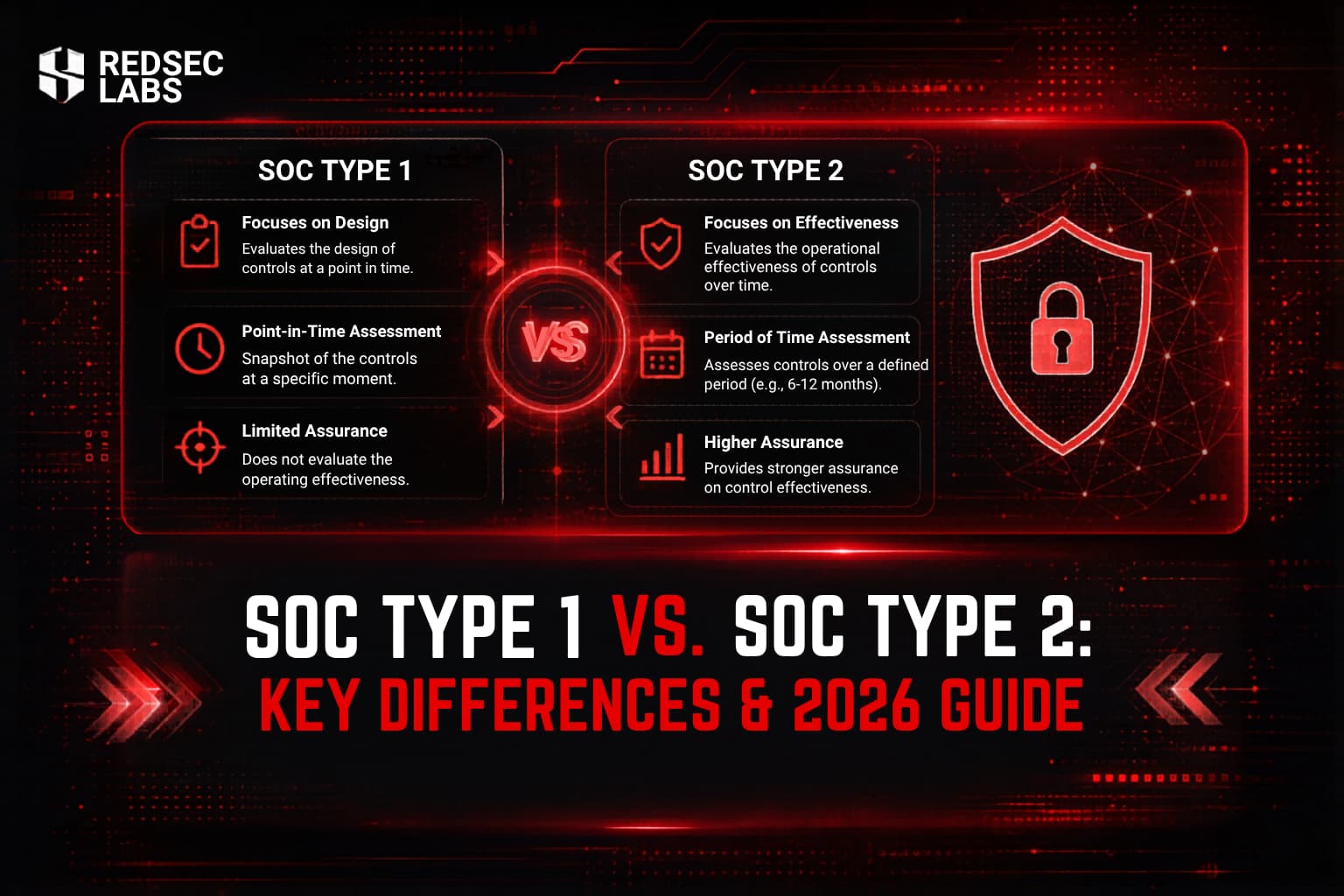
A SOC 2 Type 1 report is a point-in-time assessment. It evaluates whether your security controls are properly designed to meet the relevant Trust Services Criteria (security, availability, processing integrity, confidentiality, and privacy) on a specific date.
A simple way to think about it: a Type 1 report is like a snapshot of your security and compliance environment. The auditor reviews the controls you have in place at the time of the audit and determines whether they are appropriately designed for their intended purpose.
What the SOC 2 Type 1 Audit Process Looks Like
A Type 1 engagement generally follows this sequence:
- Scoping and Planning (Weeks 1–2) involves defining the audit scope and identifying the relevant Trust Services Criteria, selecting a licensed CPA firm, and holding initial discussions with auditors to align on expectations and requirements.
- Implementation and Documentation (Weeks 2–4) focuses on putting the required controls and policies in place, along with collecting supporting evidence such as system logs, documented policies, and system configuration details to demonstrate control design.
- Audit Testing (Weeks 4–6) is the stage where auditors review and validate the implemented controls through walkthroughs and evidence testing to ensure they are properly designed and in place.
- Reporting (Week 6+) includes the review of a draft report, followed by revisions if needed, and ultimately the issuance of the final SOC 2 Type 1 report containing the auditor’s official opinion.
What Does a SOC 2 Type 1 Audit Cost?
SOC 2 Type 1 audit fees typically range from $5,000 to $15,000 for startups and SMBs, $15,000 to $30,000 for mid-market companies, and $30,000 to $60,000 at the enterprise level, with a timeline of one to three months from readiness to report.
For a full breakdown of what drives SOC 2 pricing, our SOC 2 Audit Costs guide goes into detail.
When a SOC 2 Type 1 Report Makes Sense
Type 1 tends to be a good fit when:
- You are entering the enterprise market for the first time and need a credible security attestation within a relatively short timeframe
- A prospect has requested a SOC 2 report and a commercial opportunity depends on producing one soon
- Your organisation is in the earlier stages of building out its control environment and benefits from a structured framework to work towards
- You are planning to pursue Type 2 and want to use the Type 1 engagement as a well-organised preparation step
A Type 1 report communicates genuine intent. It tells your customers that you have invested in designing a serious control environment and that you have invited an independent third party to review it. For many organisations at an earlier stage, that is a meaningful and commercially useful position to be in.
What Is SOC 2 Type 2?
A SOC 2 Type 2 report takes the assessment considerably further. Rather than looking at controls on a single date, a Type 2 report evaluates whether your controls were suitably designed and operating effectively over an observation period, typically spanning three to twelve months.
The observation period is the defining feature of a SOC 2 Type 2 engagement. It refers to a defined timeframe, usually between 3 and 12 months, during which an auditor evaluates how effectively your security controls operate in practice. Instead of just reviewing design, the auditor checks real evidence from daily operations, such as access changes, system logs, incident records, and policy enforcement.
What Type 2 Evidence Looks Like in Practice
One of the most practical ways to understand what Type 2 actually requires is to look at the kind of evidence your auditor will want to see.
Examples include:
- Monthly or quarterly access review records
- User onboarding and offboarding tickets
- MFA and SSO configuration evidence
- Vulnerability scans and remediation tracking
- Penetration test reports
- Change approval records
- Incident response logs
- Security awareness training completion records
- Vendor risk assessments
- Backup and disaster recovery test evidence
- Endpoint management and device compliance records
This evidence is not gathered for the audit. It accumulates through the way your team operates every day during the observation window. That is the fundamental difference between Type 1 and Type 2.
What the SOC 2 Type 2 Audit Process Looks Like
- Scope Definition & Auditor Selection involves identifying the applicable Trust Services Criteria and appointing an independent CPA firm to conduct the audit.
- Pre-Audit Phase (Gap Analysis) focuses on reviewing existing controls, preparing required policies, and identifying gaps against AICPA standards before the observation period begins.
- Observation Period (3–12 Months) is the core of a Type 2 audit, where auditors assess how consistently controls operate over time, rather than at a single point in time.
- Evidence Collection runs throughout the period and includes system logs, onboarding records, and change management tickets that demonstrate controls were operating effectively.
- Audit & Fieldwork Execution includes interviews, walkthroughs, and testing procedures to verify that controls are functioning as intended across the full period.
- Report Generation & Review involves drafting the SOC 2 report, client review, and final issuance of the report, typically completed a few weeks after fieldwork ends.
End to end, a Type 2 engagement typically takes six to twelve months, depending on the observation period selected and your starting position.
What Does a SOC 2 Type 2 Audit Cost?
SOC 2 Type 2 audit fees run higher given the extended observation period, typically $12,000 to $25,000 for startups and SMBs, $25,000 to $60,000 for mid-market, and $50,000 to $100,000 or more at enterprise scale, with a timeline of six to twelve months end to end.
When to Consider Going Directly to Type 2
In some situations, it makes more sense to move directly to Type 2 rather than starting with Type 1, particularly when:
- Enterprise customers in regulated sectors, such as financial services or healthcare, specifically require a Type 2 and a Type 1 would not satisfy their procurement requirements
- Your organisation already has a relatively mature control environment and can enter an observation period with confidence
- Your business is at a stage, typically Series A or beyond, where the infrastructure is in place to sustain controls consistently
- You have sufficient time for the observation period, allowing controls to operate and be tested over several months without disrupting business priorities.
In these scenarios, going directly to Type 2 can be more practical and cost-effective than completing a Type 1 first and then beginning the Type 2 process separately.
What Is SOC 2 Type 3?
A SOC 2 Type 3 report is based on the same audit work as a Type 2, but is issued in a condensed, publicly shareable format. Where Type 1 and Type 2 reports are restricted-use documents shared only with specified parties under NDA, a Type 3 can be published on your website or shared freely as a general trust signal.
The Type 3 does not include the detailed system description, control testing results, or exceptions that appear in a Type 2. It simply conveys that an audit was conducted and that the auditor's opinion was satisfactory.
Type 3 reports are most commonly used to support trust and transparency pages, general marketing materials, or partner ecosystems where sharing a full Type 2 report is not practical or appropriate. Some organisations publish a Type 3 on their website alongside a brief summary of their security posture.
What All Three Report Types Have in Common
It is useful to be clear about what all three share, because the similarities are as commercially relevant as the differences.
All three are governed by the same AICPA Trust Services Criteria. All three require a licensed CPA firm to issue. All three cover the same control domains, with scope determined the same way regardless of which type you pursue.
And all three demonstrate to your enterprise customers that you are willing to subject your control environment to independent scrutiny, which opens conversations that a self-completed questionnaire or an internal security policy document simply cannot.
How to Think Through the Decision
There is no single right answer for every business, but there are a few practical considerations that tend to clarify the choice.
Choose Type 1 if you need to show enterprise buyers that your controls are designed properly and you need a report within a relatively short timeframe.
Choose Type 2 if your buyers expect evidence that those controls have operated consistently over time, which is typically the standard in regulated industries and mature procurement environments.
Go directly to Type 2 if you already have mature processes, recurring evidence, and no urgent need for an interim Type 1 report.
Use Type 1 as a stepping stone if you are still formalising policies, access reviews, change management, vendor reviews, and evidence collection, and want to build toward Type 2 with a structured foundation.
Add Type 3 as a public-facing complement once you have a Type 2 in place and want to make your security posture visible to a broader audience.
Common Mistakes When Choosing Between Type 1 and Type 2
This is where many organisations lose time or audit quality. Some of the most common issues we see:
- Pursuing Type 1 when a key customer explicitly requires Type 2. Ask early. Finding out late in a sales cycle that only a Type 2 will do is an avoidable situation.
- Starting a Type 2 observation period before controls are actually operating. The observation window should reflect your real operational environment, not an aspirational one. Evidence gaps at the start will show up in the final report.
- Assuming policies alone are sufficient. Documentation is necessary but not enough for Type 2. The auditor wants to see evidence that those policies are being followed in practice.
- Choosing too many Trust Services Criteria too early. Adding Availability, Confidentiality, or Privacy to scope adds meaningful audit effort. Start with Security unless your customers are specifically asking for additional criteria.
- Underestimating the effort involved in recurring evidence. Access reviews, change approvals, vendor assessments, and incident response logs need to happen regularly and be recorded consistently throughout the observation period.
- Treating SOC 2 as a one-off project. Type 2 is an ongoing operating model. Organisations that treat it as a project tend to struggle at renewal because the evidence collection habits never became routine.
- Failing to define system boundaries clearly before fieldwork begins. Unclear scope leads to disagreements mid-audit, expanded timelines, and sometimes additional cost.
Transitioning from Type 1 to Type 2
A Type 1 report is very much a starting point rather than an endpoint. For many organisations, it is the beginning of a compliance journey that progresses naturally into an annual Type 2 cycle.
The transition is straightforward in structure: once your Type 1 report is issued and your controls are running as designed, the observation period begins. After the agreed window, commonly six months, your auditor returns to test operating effectiveness and issues the Type 2 report.
That said, the transition is not automatic in practice. If controls are not consistently performed and evidenced after the Type 1 report date, the later Type 2 audit can still result in exceptions.
The organisations that find this transition smooth are generally those that treat the Type 1 engagement as an operational foundation rather than a one-time event. Embedding controls into daily processes makes the move to Type 2 a natural next step rather than a scramble.
Working with RedSecLabs on Your SOC 2 Journey
Whether you are weighing up Type 1 vs Type 2 for the first time, preparing for your first formal engagement, or looking to move from Type 1 into an annual Type 2 cycle, our SOC 2 Compliance Services are built to support you at each stage.
Get in touch with the RedSecLabs compliance team to discuss where you are and what the right next step looks like.
Frequently Asked Questions
Will enterprise customers accept a SOC 2 Type 1 report?
Yes, often for early-stage due diligence or to close deals quickly. However, most enterprises will still expect a SOC 2 Type 2 within 12–18 months for stronger assurance.
Is a SOC 2 Type 2 report more valuable than a Type 1?
Yes. Type 2 is more valuable because it proves controls work over time (typically 3–12 months), not just at a single point in time.
How often do I need to renew my SOC 2 report?
Usually every 12 months, as customers expect an up-to-date report to confirm controls are still effective.
What is a bridge letter, and when might I need one?
A bridge letter confirms no material changes in controls during the gap between an expired report and a new audit period.
Does SOC 2 compliance mean my systems are fully secure?
No. It shows your controls are properly designed and operating, but it doesn’t guarantee complete security or prevent all incidents.
Is SOC 2 Type 3 worth pursuing?
Only as a supplement to Type 2. It’s useful for public trust signals, but not sufficient for enterprise procurement on its own.