At RedSecLabs, we get asked the same question at the start of almost every client engagement: "What is this going to cost us?"
It is a fair question. And the honest answer is that SOC 2 compliance pricing is genuinely wide from $3,000 on the low end to well over $100,000 on the high end, for what appears on paper to be the same report.
After running readiness assessments, scoping audits, and guiding companies through the full SOC 2 compliance services process across industries and company sizes, we have seen both extremes and everything in between.
What we have learned is that the number on your quote is not random. Every dollar of difference comes down to a handful of decisions, most of which are made before the auditor is ever engaged. Make them well and you control your cost. Make them poorly and you pay twice.
This article is what we tell clients before they spend a dollar.
Quick Price Anchors:
- SOC 2 audit fee alone: $5,000 – $100,000+
- Total first-year cost (audit + prep + tools + internal time): $25,000 – $200,000+
- Ongoing annual cost from year 2: $15,000 – $40,000
The single biggest factor driving that range is “auditor selection”. Specialist boutique firms and Big Four firms routinely quote 2–3x differently for identical scope before a single control has been tested.
How Audit Firms Actually Price SOC 2 Engagements
Before looking at SOC 2 pricing, it helps to understand how audit firms actually calculate their fees.
Most firms use either a blended hourly rate model or a fixed-fee pricing model. In hourly engagements, a senior auditor or partner might bill at $250–$350/hour, while staff and senior auditors typically bill at $100–$175/hour. Fixed-fee engagements are also common among CPA firms.
A legitimate Security-only SOC 2 Type 2 audit usually requires at least 60–80 auditor hours for walkthroughs, evidence testing, report drafting, and internal review. At standard industry rates, that puts a realistic audit floor around $9,000–$15,000.
That is why extremely cheap audits ($3,000–$5,000) are a red flag. At that price, there simply are not enough hours to perform meaningful testing. In many cases, companies receive templated reports with minimal real audit work behind them.
Some firms also intentionally underprice audits to later upsell remediation consulting, policy writing, or ongoing advisory services. If a quote seems unusually low, ask what is excluded.
At the other extreme, quotes of $60,000–$100,000+ are usually driven by brand premium rather than audit complexity. Large firms like Deloitte, EY, and PwC build partner billing rates, liability costs, and institutional overhead into every engagement.
The 5 Variables That Determine Where Your Quote Lands
1. Audit Type: Type 1 vs. Type 2
This is the single largest cost driver, and the decision most clients want to rush past.
A Type 1 audit reviews whether your controls are designed correctly at one point in time. It is faster and less expensive, typically completable in one to three months.
A Type 2 audit tests whether those controls actually operated effectively over a sustained period, usually three to twelve months. The auditor reviews evidence collected across that entire window, tests more samples, and spends significantly more time in fieldwork.
Our recommendation to most first-time clients: Start with Type 1. Use the report to unblock immediate deals. Use the next six to nine months to operate controls properly and build clean evidence. Then complete Type 2 in the following cycle.
That said, Type 1 is not always sufficient. Enterprise procurement programs at Fortune 500 companies, regulated industry buyers, and larger financial institutions increasingly require Type 2 as a baseline. If your immediate pipeline is concentrated in those segments, starting with Type 2 may be the right call.
2. Scope: Trust Services Criteria and Systems Included
SOC 2 has five Trust Services Criteria: Security, Availability, Processing Integrity, Confidentiality, and Privacy. Security is mandatory. Every other criterion is optional, and each one added expands auditor scope, increases testing hours, and raises your quote.
One principle we apply in every scoping conversation: scope is a choice, not a default. The vast majority of companies going through SOC 2 for the first time need Security only. Adding criteria speculatively is one of the most consistent ways companies overspend on their first audit.
A few months back, a healthcare SaaS company we worked with pursued Security plus Confidentiality because their contracts required it. As a result, audit hours increased by roughly 60–70% compared to a Security-only engagement of similar size. The expanded evidence sampling around PHI workflows and data handling drove most of that increase. The criteria addition was correct for their buyers, but it was not free.
Add scope when a specific customer requires it in writing. Not before. The same principle applies to systems. If only one product handles customer data, that is your audit scope. Including internal tools, dev environments, or low-risk systems inflates the scope and the invoice without adding anything your buyers will ever see.
3. Infrastructure Complexity
Auditors price based on effort, and effort scales with the complexity of your environment. A 15-person startup running a single AWS account with standard configurations requires far less auditor time than a 200-person company running federated identity across multiple cloud accounts, dozens of SaaS integrations, and a distributed engineering team.
Some specific environments that consistently expand audit effort and therefore cost:
Federated identity and decentralized access management. When user access is managed across multiple identity providers, inheritance is inconsistent, and access reviews require cross-system reconciliation, auditors spend significantly more time testing access controls.
Multi-tenant SaaS architecture. Demonstrating logical separation between customer environments requires more detailed configuration evidence, more walkthroughs, and more sampling.
Inherited cloud controls. Companies relying heavily on cloud-native security tooling, AWS Security Hub, GCP's Security Command Center, need to demonstrate which controls are genuinely implemented versus inherited from the provider. Auditors have to understand the boundaries, which takes time.
Decentralized engineering teams. More employees mean more access reviews, more background check records to verify, more onboarding and offboarding evidence to test. More systems mean more controls to examine, more log samples to pull, more configurations to validate.
4. Auditor Selection
Selecting the right auditor is less about choosing the biggest name and more about choosing a firm with the right accreditation, relevant SaaS experience, and a strong quality record.
Audit fees for the same scope vary dramatically across firm types, and understanding the tiers helps you benchmark any quote you receive:
- Specialist firms (A-LIGN, KirkpatrickPrice, Schellman, Prescient Security) typically quote $15,000–$75,000 for a Type 2 engagement. They are high-volume, SaaS-experienced, and competitively priced. For most startups and mid-market companies doing their first SOC 2, this is where the best value lives.
- Regional CPA firms (Moss Adams, Withum, Aprio, Linford & Company) generally run $20,000–$95,000 for Type 2. They offer full-service relationships and partner-level attention, which matters if you are already a client for tax or advisory work.
- Mid-tier nationals (RSM, Grant Thornton, BDO, Baker Tilly) land at $30,000–$120,000 for Type 2. They bring Big Four-comparable quality standards and deeper industry expertise, which is worth the premium for PE-backed firms or companies pursuing multi-framework audits.
- Big Four firms (Deloitte, PwC, KPMG, EY) regularly quote $60,000–$450,000 for the same Type 2 scope. The premium reflects brand, global delivery capability, and institutional overhead, not audit complexity.
When evaluating any audit firms, focus on three factors first:
- Whether the firm is licensed and accredited to perform AICPA-standard audits
- Whether the team has direct experience auditing SaaS and cloud-native businesses
- Whether their peer review status is current and in good standing
One of the most overlooked but important checks is verifying the firm's peer review record. Every CPA firm performing AICPA-standard audits must undergo an independent peer review of its audit practices every three years. These results are publicly available through the AICPA Peer Review Search.
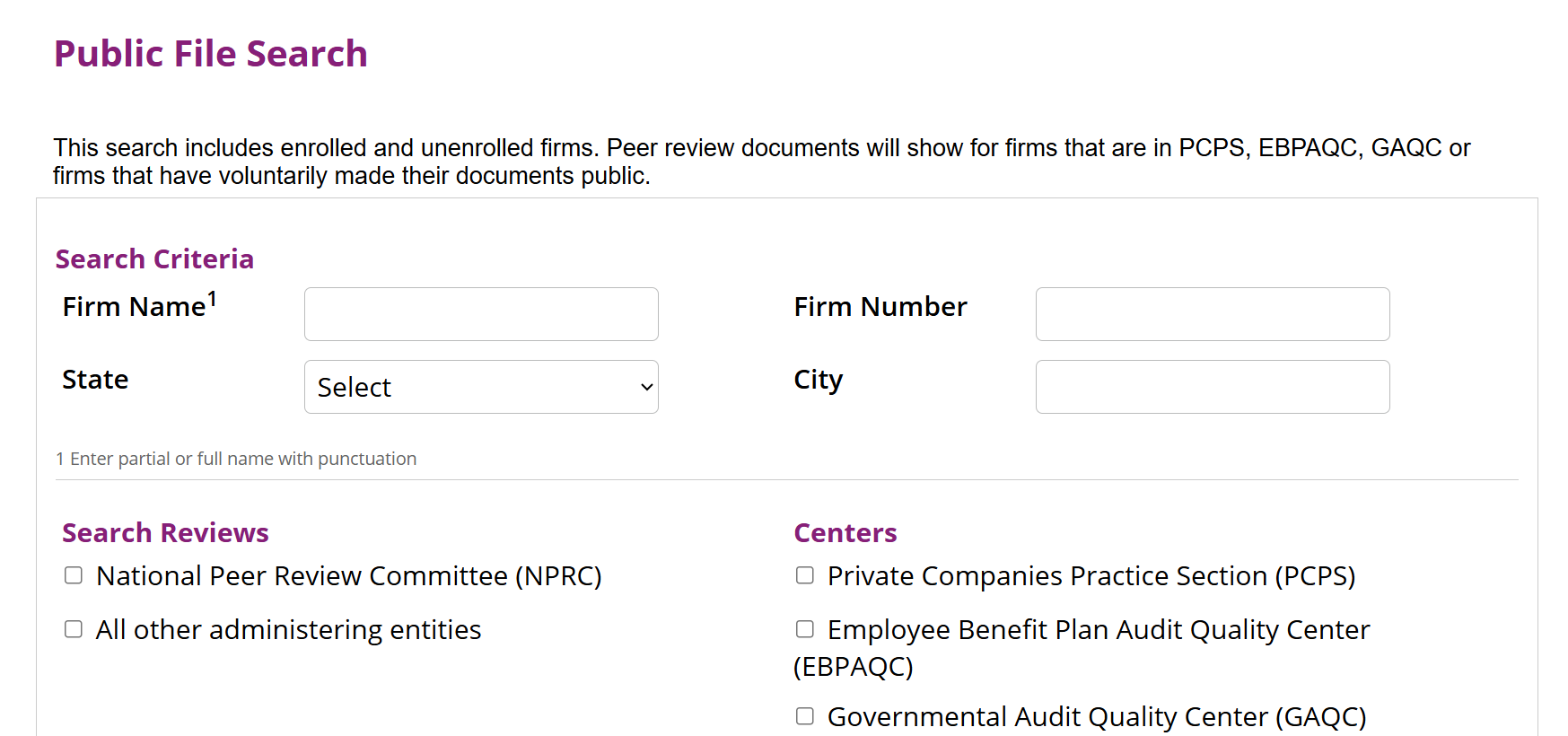
If a firm does not appear in the database, has an expired review, or shows deficiencies, that should be considered a major red flag regardless of how attractive the pricing may seem.
5. Compliance Automation vs. Manual
Compliance automation platforms such as Vanta, Drata, Sprinto, and Delve can materially affect the total cost of a SOC 2 program, both positively and negatively.
On one hand, they reduce the amount of manual evidence collection, audit coordination, and spreadsheet-driven tracking your internal team has to manage. In many environments, this lowers audit preparation effort and shortens fieldwork timelines. Independent research on platforms like Vanta and Drata shows audit time reductions of 78–82%, with payback periods as short as three months.
On the other hand, these platforms introduce their own direct software costs, implementation overhead, and operational complexity. Companies often assume buying a platform automatically makes them audit-ready, which is not true.
The audit fee is almost always the smallest line on the SOC 2 budget.
Internal labor is where most programs bleed money, typically 200–500 hours of engineering, security, IT, and leadership time across the full audit cycle. At a loaded rate of $150–$200/hour, that translates to $30,000–$100,000 in opportunity cost before any external payment is made.
Automation platforms attack that hidden cost directly, and for lean internal teams, the platform often pays for itself on the first audit alone.
Quick Platform Comparison
The SOC 2 Phases And What Each One Actually Costs
Most companies budget for the audit fee and miss everything around it. SOC 2 has five distinct phases, and the audit fee is only one of them.
Phase 1: Gap Assessment ($5,000 – $25,000)
A gap assessment is a structured comparison of your current controls against SOC 2 requirements. It identifies what you have, what is missing, and what needs to change before a formal auditor is engaged.
Skipping this phase is the single most common way companies turn a manageable cost into an expensive one. When gaps surface during formal audit fieldwork instead of beforehand, the remediation cost is identical but now you also pay re-engagement fees, extended fieldwork costs, and the opportunity cost of delayed deal cycles.
Phase 2: Remediation and Implementation ($0 – $50,000+)
Once the gap assessment identifies shortfalls, they have to be fixed. This phase is typically the largest external cost driver, and the hardest to estimate in advance because it depends entirely on how mature your security program already is.
Remediation typically includes: writing and formalizing 15–20 security policies, implementing technical controls (MFA enforcement, centralized logging, endpoint management, encryption configurations), conducting a formal risk assessment, establishing a vendor risk review process, and completing security awareness training.
For companies with an existing security foundation, this can cost nearly nothing, mainly documentation work. For companies starting from scratch, external consulting fees can run $30,000–$50,000+ on top of significant internal engineering time.
Phase 3: Observation Period, Type 2 Only ($0 direct, high internal cost)
For Type 2 audits, there is no auditor invoice during the observation period but this phase is far from free. Your team must operate controls consistently, collect evidence continuously, and maintain processes without drift across three to twelve months.
This is where the hardest part of SOC 2 actually lives and it is the part most articles underexplain. The real challenge is not technical implementation. It is operational discipline: consistent evidence collection, clear control ownership, governance cadence, and what practitioners call control culture.
Phase 4: Formal Audit Fieldwork (Included in auditor fee)
The auditor tests your controls, reviews evidence samples, and conducts interviews with key personnel. Fieldwork for Type 1 typically takes two to four weeks of active engagement. Type 2 fieldwork runs three to six weeks. Complexity extends both.
Your team's involvement during fieldwork is significant. Budget 40–80 hours of internal time: answering auditor questions, pulling additional evidence, explaining system configurations, attending interviews.
Phase 5: Report Issuance (4–6 weeks after fieldwork)
The auditor drafts the report, your team reviews it for factual accuracy, and the final SOC 2 report is issued. Exceptions documented in Type 2 reports are not binary failures, auditors explain each one and document your response but they do slow deal cycles and invite buyer scrutiny. The thoroughness of phases one through three determines the cleanliness of phase five.
The Costs That Never Appear on an Auditor Invoice
The audit fee is one line item. These costs are real and frequently missed.
For a 30-person company, the baseline tool stack adds $5,000–$15,000 per year. This cost does not appear in most audit quotes.
Penetration testing ($5,000–$25,000/year) is not strictly required by SOC 2, but most enterprise buyers expect to see annual pen test results alongside your report.
Failed or delayed audits are the most expensive hidden cost and the most avoidable. When gaps surface during fieldwork instead of during a gap assessment, the consequences stack: re-engagement fees, extended evidence windows, delayed report issuance, and internal teams stuck in audit mode for months longer than planned.
Real SOC 2 Cost by Company Stage
These figures include audit fees, gap assessment, remediation, compliance platform, penetration testing, and internal time.
What This Looks Like In Practice
To move these numbers from abstract to concrete:
Scenario A: 40-person B2B SaaS on AWS, Security-only Type 1
A company with Okta, GitHub, and Vanta already in place, reasonable access control hygiene, no prior SOC 2 work:
- Gap assessment: $8,000
- Vanta (annual): $12,000
- Remediation (primarily policy work + minor tooling): $10,000–$15,000
- Audit fee (Type 1): $12,000
- Internal time (~150 hours): ~$22,000 opportunity cost
Total cash outlay: ~$47,000 | Total including internal time: ~$69,000
Scenario B: 90-person SaaS company, Security + Confidentiality, Type 2
A company with multi-cloud infrastructure, federated identity, and an enterprise pipeline requiring Type 2:
- Gap assessment: $15,000
- Drata (annual): $16,000
- Remediation (technical controls + policy): $30,000–$40,000
- Pen test: $12,000
- Audit fee (Type 2): $35,000
- Internal time (~350 hours): ~$52,000 opportunity cost
Total cash outlay: ~$108,000–$118,000 | Total including internal time: ~$160,000–$170,000
These are illustrative of your actual numbers shift based on existing maturity, infrastructure complexity, and auditor selection. But the pattern holds: in every scenario, the formal audit fee is the smallest component of the total.
How to Reduce Your SOC 2 Cost Without Undermining the Report
Scope to what buyers actually require. Start with Security only. Add additional Trust Services Criteria when a specific customer requires them in writing, not speculatively. Every TSC you add costs real money and creates ongoing maintenance.
Start with Type 1, not Type 2: unless your pipeline forces otherwise. Type 1 unblocks most enterprise deals immediately and gives you the time to build clean evidence before the Type 2 observation period. Rushing to Type 2 before controls are stable produces a harder audit and a weaker report. But know your buyers: if your primary targets already require Type 2, skipping Type 1 is the right move.
Run a gap assessment before engaging the auditor. The cost ($5,000–$15,000) is consistently lower than the cost of gaps surfacing during fieldwork.
Verify your audit firm's peer review status before signing. Check the public AICPA peer review database. If the firm is not current and passed, do not engage them regardless of price.
Configure your compliance automation tool before scoping the audit. Get the platform connected, validate the integrations, and confirm evidence is collected correctly. Then have the scoping conversation. The quote you receive will reflect the lower workload and you will avoid the false confidence that a purchased tool alone creates.
Bundle frameworks if you need more than one. If SOC 2 and ISO 27001 are both on your roadmap, pursuing them together reduces total cost by 30–40% compared to sequential engagements. The control overlap is significant enough to make simultaneous pursuit materially cheaper.
Clarify control ownership before the observation period starts. The most common cause of Type 2 audit exceptions is not missing tools, it is missing ownership. Decide who is responsible for each control, how evidence is collected, and what the escalation path is when a control fails. Document it before the clock starts running.
Is SOC 2 Worth It?
SOC 2 compliance is often worth it and in many cases necessary for B2B SaaS companies handling sensitive data or selling to enterprise customers. It shortens security review cycles, reduces procurement friction, and signals to buyers that your security posture has been independently validated.
Beyond sales enablement, it also forces stronger internal security discipline: access control hygiene, monitoring coverage, incident response, vendor risk management. Most companies that go through the process properly find that the operational improvements have value independent of the report itself.
The companies that get the most out of it treat SOC 2 not as a one-time compliance project but as the beginning of an ongoing security program. The ones that struggle treat it as a documentation exercise and usually end up doing it twice.
Reach out to our SOC 2 consultants at RedSecLabs to start with a gap assessment that defines your scope and helps you avoid unnecessary audit costs upfront.
Frequently Asked Questions
Can we self-certify instead of hiring an auditor?
No. SOC 2 requires a licensed CPA firm. Self assessments help internally but are not accepted by customers or procurement teams.
What does the renewal cost?
Usually 75 to 90 percent of the first year. Early work like policies and gap fixes is the heavy part. Renewals mainly re test controls over time.
How long does a quote stay valid?
Typically 30 to 90 days. Pricing depends on scope, headcount, and systems, so changes can update the quote.
Is penetration testing included in the audit fee?
Almost never. Pen testing is a separate engagement, typically $5K–$30K depending on the size and complexity of your environment.
What happens if we miss a control during the audit?
Minor issues can often be fixed during the audit. Major gaps can extend timelines or lead to a weaker report outcome.
Can we limit the scope to keep costs down?
Yes. Many teams start with Security only and a smaller system boundary. You can expand scope in later audits.