And How to Fix Them Before Your Assessment
PCI DSS audits rarely fail because organizations ignore security. They fail because of operational gaps: missed scans, undefined scope, documentation that does not reflect reality, and segmentation that was configured but never actually tested.
With PCI DSS v4.0.1 now the active standard, documentation requirements are more rigorous, assessors are focused on continuous control effectiveness, and the tolerance for assumption-based compliance has dropped to zero.
At RedSecLabs, our readiness assessments consistently surface the same five root causes across fintechs, payment processors, and SaaS platforms of all sizes. Fixing them before the assessor arrives can save your organization tens of thousands of dollars in remediation costs and months of compliance delays.
REASON 01: Incorrect Scope Definition
Scope errors are the single largest cause of PCI audit surprises and the most expensive to fix mid-assessment.
PCI DSS requires you to identify and confirm the scope of your cardholder data environment (CDE) at least annually and after any significant change. In practice, most organizations scope their obvious systems: the payment gateway, the POS terminals, the card database, and stop there.
What assessors routinely find during audits are the systems nobody thought to include:
• Backup servers that store cardholder data as a side effect of system-wide backups
• Logging and SIEM platforms that ingest payment transaction logs
•Development and staging environments using production data copies
•Identity providers and Active Directory systems that control CDE administrative access
• Cloud services such as S3 buckets, Lambda functions, and API Gateways connected to payment flows
• Monitoring tools with agent-level access to in-scope hosts
Each one of these, once discovered, must be brought immediately into scope. That means controls, documentation, and testing applied retroactively under audit pressure.
How to prevent scope failures
Run a formal scoping exercise at least 60 days before your assessment. It should cover:
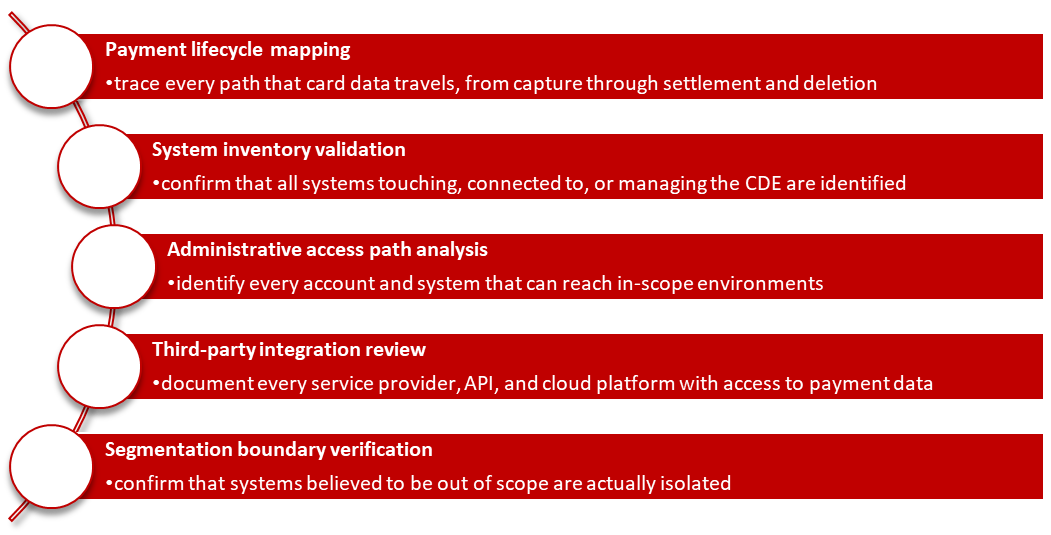
A well-executed scoping exercise is not a cost. It is insurance. It replaces audit-day surprises with planned, manageable remediation.
REASON 02: Missing or Outdated Data-Flow Documentation
Documentation failures often reflect the gap between how an organization thinks its environment works and how it actually works.
PCI DSS requires accurate, current diagrams showing how account data moves through your environment: where it enters, is processed, is stored, is logged, is backed up, and is deleted. These must be updated whenever infrastructure changes.
In real-world assessments, the documentation problems we most commonly encounter include:
• Network diagrams that were accurate 18 months ago but do not reflect cloud migrations or new integrations
• Payment data-flow diagrams that show the intended architecture, not the actual one
• Missing documentation for third-party APIs that interact with payment applications
• Undocumented log aggregation or backup storage systems that receive cardholder data
• No documentation for cloud-native services such as message queues and serverless functions processing payment events
When an assessor cannot trace how payment data moves through your environment, they cannot verify that controls are applied appropriately. The result is usually scope expansion, additional testing requirements, and failed control reviews.
How to prevent documentation failures
Maintain two core artifacts as living documents, updated during infrastructure changes and not created for the audit:
|
Required Documentation: Two
Core Artifacts |
|
Network
architecture diagram: showing all zones, firewalls, segmentation boundaries,
system connectivity, and network controls |
|
Payment
data-flow diagram: showing precisely where payment data enters, moves, is
processed, stored, retained, and removed, including all third-party
touchpoints |
Both documents should be owned by a named individual, version-controlled, and reviewed as part of any change management process involving the CDE. An assessor who can trace payment data accurately through your diagrams is an assessor who trusts your environment.
REASON 03: Missing or Failed ASV Scans
ASV scanning failures are among the most avoidable PCI compliance findings and they continue to occur at a surprisingly high rate.
PCI DSS requires organizations to perform external vulnerability scans at least once every three months using a PCI Approved Scanning Vendor (ASV). Scans must cover all internet-facing in-scope systems, identify vulnerabilities, and produce passing results, with remediation and rescans completed where findings are identified.
The ways organizations fail this requirement are predictable:
• Quarterly scans are missed because ownership is unclear between security and infrastructure teams
• Scans fail and no one follows through on remediation or rescans
• New internet-facing assets are deployed without being added to the scan scope
• Scan credentials expire or scan coverage narrows without detection
• Organizations present passing scans to assessors but cannot show a continuous quarterly cadence
A single missed quarter is a compliance finding. A pattern of missed quarters is a significant audit problem, and one that assessors increasingly scrutinize under PCI DSS v4.0.1's emphasis on continuous compliance.
How to prevent ASV failures
Treat ASV scanning as an operational process, not a periodic task:
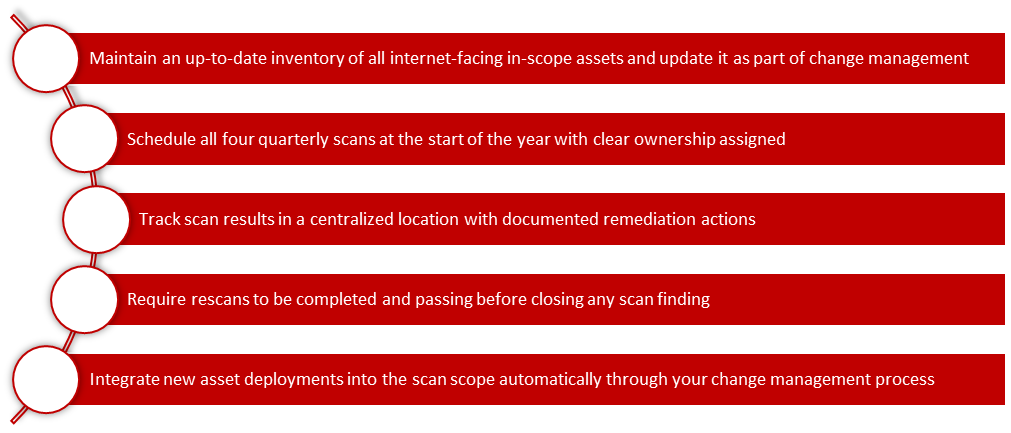
The organizations that consistently pass ASV reviews are not the ones that scan better. They are the ones that treat scanning as a continuous operational control, not an annual sprint.
REASON 04: Weak Access Control Governance
Access control failures remain one of the most frequently cited findings in PCI DSS assessments and one of the most consistent signals of a compliance program under strain.
PCI DSS v4.0.1 requires organizations to restrict access to cardholder data by business need-to-know, enforce multi-factor authentication (MFA) for all CDE access, perform access reviews at least every six months (every 180 days) for many privilege types, and remove unnecessary or outdated access promptly.
In practice, access rights accumulate. Every audit we conduct surfaces some version of the following:
• Former employees or contractors with active accounts and CDE access, often months after offboarding
• Developers with unnecessary production privileges inherited from an earlier project phase
• Shared administrative accounts with no individual accountability
• Service accounts with broad permissions that were provisioned for a specific task and never reviewed
• Access reviews completed but not documented, producing no evidence for assessors
• MFA enforced for some CDE access paths but not others, creating exploitable gaps
Access drift is not a security failure unique to careless organizations. It is a natural consequence of operational pace in the absence of deliberate governance. The difference between compliant and non-compliant organizations is almost always process maturity, not intent.
How to prevent access control failures
Perform a structured access governance review well before your assessment:
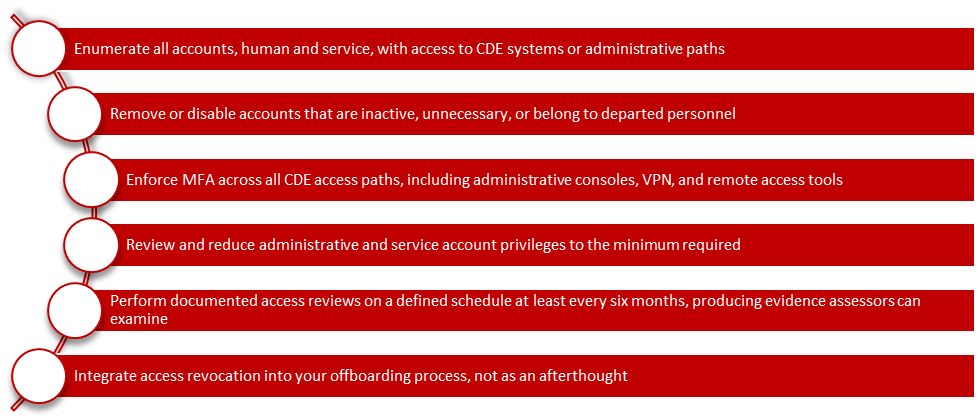
Access governance should be understood as a security control, not a compliance checkbox. The organizations with the strongest access profiles are the ones that review it on schedule, not the ones who scramble to clean it up in the 30 days before an audit.
REASON 05: Segmentation That Was Never Properly Tested
Segmentation is one of the most powerful tools for reducing PCI scope and one of the most commonly misused.
Many organizations invest in network segmentation specifically to limit the scope of their PCI assessment. The logic is sound: if cardholder data systems are isolated from the rest of the network, only those isolated systems need to meet PCI requirements. But segmentation only reduces scope if it actually works, and proving that it works requires testing.
PCI DSS v4.0.1 requires annual penetration testing of segmentation controls and additional testing after significant infrastructure changes. Despite this, segmentation testing gaps are extremely common:
• VLANs are configured but firewall rules allow unrestricted inter-VLAN communication, negating the isolation
• Troubleshooting exceptions were opened during an incident and never closed, remaining as permanent access paths
• Cloud security groups are inconsistently applied, allowing traffic to bypass network segmentation
• Segmentation was validated during initial deployment but has not been retested through infrastructure changes
• Penetration tests were scoped to exclude segmentation validation, leaving the most important control unexamined
When segmentation fails, systems that the organization considered out of scope may suddenly become part of the CDE. In a worst case, this can expand audit scope dramatically, bringing dozens of systems into compliance requirements retroactively.
How to prevent segmentation failures
Treat segmentation as a security control that must be continuously validated, not a one-time architecture decision:
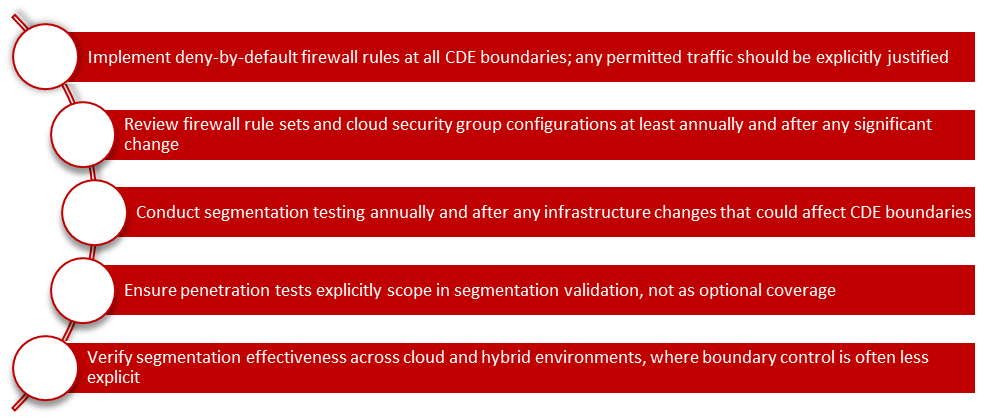
If segmentation is a key part of your scope reduction strategy, strong documented evidence that it works is not optional. It is the foundation of your entire scoping argument.
Why These Five Failures Are Connected
Although these failures appear distinct, they almost always share a common root cause: treating compliance as a periodic audit exercise rather than a continuous operational discipline.
The pattern recurs across every engagement:
Incorrect scoping produces incomplete documentation. Incomplete documentation leads to incomplete testing. Incomplete testing hides segmentation weaknesses. Weak governance allows access drift and missed scans to accumulate unnoticed until the assessor arrives.
The organizations that consistently pass PCI audits with minimal findings are not the ones with perfect security postures. They are the ones that have built compliance into their operational rhythm, with defined ownership, regular review cycles, and a culture of evidence.
Final Thoughts
PCI DSS audit failures are rarely caused by sophisticated security problems. They are caused by operational gaps: systems that slipped out of scope, documentation that did not keep pace with infrastructure, scans that were no one's clear responsibility, access rights that accumulated quietly, and segmentation that was assumed to work but never confirmed.
The solution to each of these problems is not primarily a technical one. It is a program management one: clear ownership, consistent processes, and the discipline to treat compliance as something that happens every day, not every 12 months when the assessor shows up.
Organizations that build that discipline pass their audits. Organizations that do not are often surprised by findings, by scope expansion, and by the cost of fixing under pressure what could have been fixed at leisure.
About RedSecLabs
RedSecLabs helps fintechs, payment companies, and SaaS platforms prepare for PCI DSS assessments and avoid costly audit failures. Our services include PCI DSS readiness assessments, scoping and segmentation validation, penetration testing, ASV coordination, and compliance gap remediation.
If your PCI assessment is approaching, identify the gaps before your assessor does.
Visit: redseclabs.com | Contact: [email protected]