Most organizations today rely on annual penetration testing, primarily driven by compliance requirements under various standards and frameworks such as SOC 2, ISO 27001, and PCI DSS. This approach was effective in the past, when applications had fewer major releases and were not highly dynamic in nature. However, with the evolution of cloud infrastructure and CI/CD pipelines, releases now occur far more frequently. As a result, even a single line of code with a missed input validation or authorization check can be detrimental to the overall application security posture; therefore, annual penetration testing no longer suffices in many scenarios.
CI/CD has evolved into secure CI/CD, where static analysis tools, SCA, and DAST components are incorporated earlier in the development lifecycle. While static analysis and secret-scanning solutions are commonly used, a major limitation remains their inability to effectively detect issues such as business logic flaws and authorization weaknesses. As applications continue to grow in complexity, identifying these types of vulnerabilities becomes increasingly challenging.
To keep pace with this reality, regulators have increasingly begun exploring and recommending continuous penetration testing. Traditional annual penetration testing is unable to keep up with the weekly, or even daily, changes introduced in modern cloud-based and DevOps-driven environments.
Penetration Testing as a Service (PTaaS) addresses this gap by providing a continuous validation approach designed for organizations operating in DevOps environments, cloud-native architectures, and with rapidly expanding attack surfaces.
Let's examine PTaaS and challenges with the traditional penetration testing approach and which approach can be more suitable for your organizations.
Challenges with Annual Penetration Testing Alone
Annual penetration testing has been the industry standard for decades, meeting compliance and regulatory requirements, comprehensive assessment, and fresh external perspective. But it has limitations in modern environments.
- The Temporal Coverage Gap
When you conduct an annual pentest, it is a point-in-time engagement, i.e., a snapshot of your security posture at that moment. However, given that environments these days are dynamic, code tends to change on a frequent basis, new SaaS applications are integrated, IAM roles are modified, API endpoints change, or new cloud resources are deployed. This can introduce vulnerabilities.
Bottom line being, “Your security landscape transforms continuously, but your validation occurs annually”
According to ENISA research indicates that most successful breaches exploit vulnerabilities known for more than 03 months. That's significant exposure between annual tests.
- The Factor of Digital Transformation
Another factor behind this is that modern organizations encounter tremendous complexity:
• Cloud expansion: Azure, Resources span AWS and GCP with continually changing configurations
• API proliferation: Microservices provide hundreds of endpoints requiring additional validation
• SaaS sprawl: Large enterprises can use 100+ applications, each can come with possible misconfigurations
• DevOps velocity: In large enterprises, code deliveries occur several times a day.
This isn't your infrastructure from five years ago, and your security testing approach needs to evolve accordingly.
- Attacker Landscape changing
With the advent of tools such as WormGPT, FraudGPT, and other LLM-based platforms, the attacker landscape is rapidly evolving. These tools enable attackers to automate large parts of the attack lifecycle, generate highly contextual and convincing phishing content, identify vulnerabilities faster, and adapt their techniques in real time. As a result, attacks are becoming more scalable, targeted, and sophisticated, reducing the effort and skill required to launch effective campaigns and increasing the overall risk to organizations.
What Is PTaaS?
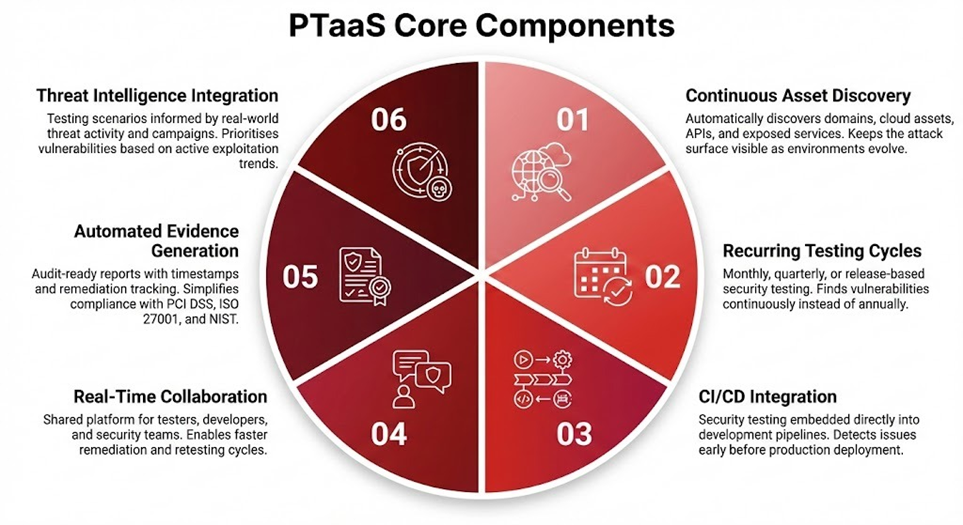
Penetration Testing as a Service (PTaaS) combines the rigor of traditional penetration testing with continuous validation mechanisms. It typically involves a platform with dashboards that enable collaboration and automated monitoring. If traditional penetration testing is like an annual health checkup, PTaaS is like having a fitness tracker with regular monitoring throughout the year. Both have value, but they serve different purposes.
Following diagram explains core components of PTaas:
Why Organizations Are Adopting PTaaS
Enterprises have started adopting PTaaS for multiple reasons:
- Regulatory Pressure
Modern compliance frameworks increasingly expect ongoing validation rather than a single annual penetration test:
• DORA: Requires EU financial institutions to conduct annual resilience testing and TLPT (Threat led Penetration Testing) every three years. PTaaS provides continuous evidence between TLPT cycles.
• NIS2 Directive: Designed cybersecurity requirements for critical and important entities, it mandates regular vulnerability assessments and security testing for essential and important entities across the EU.
• PCI DSS v4.0.1: An annual penetration testing is required after significant changes and strengthens segmentation validation, where continuous testing excels.
The pattern is clear: regulators recognize that annual testing alone does not reflect modern risk environments. - DevOps and Cloud-Native Reality
Organizations practicing DevOps deploy code daily or weekly. Waiting twelve months between security assessments creates significant risk windows.
PTaaS aligns security validation with development velocity by testing new features before production, validating infrastructure-as-code changes, detecting misconfigurations within days, and integrating security feedback into sprint cycles. - Cloud Configuration Drift
Cloud environments change continuously. Research suggests that most cloud breaches result from customer misconfigurations such as overly permissive IAM policies, public storage buckets, weak security groups, and excessive service account permissions. PTaaS platforms monitor configuration changes and trigger targeted assessments automatically. - SaaS Security Complexity
Organizations rely on 100+ SaaS applications for critical operations, each introducing attack surface through OAuth consent phishing, misconfigured sharing permissions, excessive third-party integrations, and conditional access policy gaps. Traditional annual testing rarely covers SaaS environments comprehensively.
What PTaaS Tests: Your Complete Attack Surface
APIs are the backbone of modern applications and a primary attack vector. PTaaS provides ongoing API security validation that detects issues before attackers exploit them.
Common findings include:
• Insecure Direct Object References (IDOR): Predictable resource identifiers allow enumeration and unauthorized access. Continuous testing identifies these issues as new endpoints are deployed.
• Broken Authentication: Users can access or modify other users data by manipulating object identifiers. PTaaS detects these flaws through systematic authorization testing across endpoints.
• Mass Assignment: APIs accept more properties than intended, allowing attackers to modify sensitive fields such as roles or payment values.
• JWT vulnerabilities: This can involve weak signing algorithms, missing expiration validation, or exposed secrets enabling account takeover.
• API rate-limiting gaps: Missing or misconfigured limits enabling credential stuffing, scraping, or denial-of-service attacks.
Real-world example: A financial services API allowed users to view transactions by supplying a transaction ID without verifying ownership. PTaaS detected this issue in the first testing cycle.
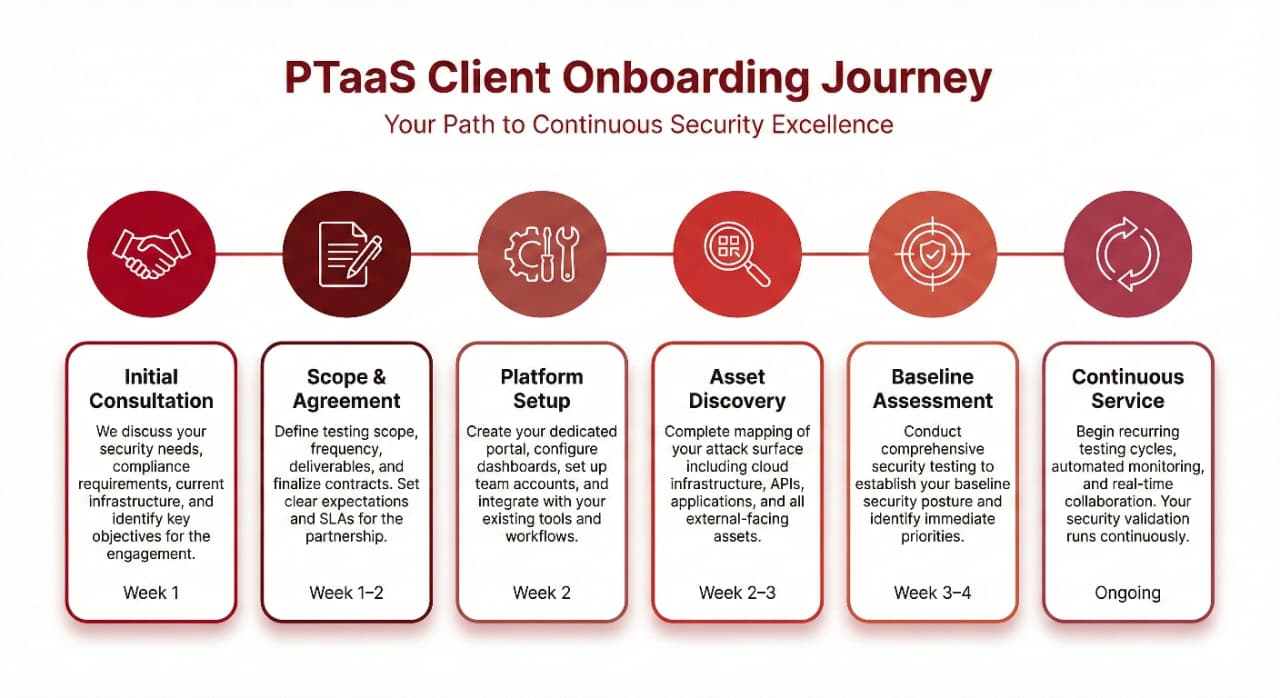
PTaas On-boarding Procedure
Following is a diagram involving on-boarding process:
Cloud Infrastructure
Modern platforms introduce constantly changing security risks across identity, compute, storage, networking, and application layers. Penetration Testing as a Service (PTaaS) provides systematic and continuous validation across these areas, including:
Identity and Access Management
• Overly permissive access policies that violate the principle of least privilege
• Privilege-escalation paths through misconfigured identities, service accounts, or application integrations
• Excessive use of broad or administrative roles instead of scoped permissions
Storage and Data Security
• Publicly accessible storage resources exposing sensitive data
• Unencrypted data at rest due to misconfigured storage or database settings
• Weak access controls enabling unauthorized data access or exfiltration
Compute and Runtime Security
• Insecure metadata or instance configuration enabling credential exposure
• Over-privileged workloads and functions with unnecessary permissions
• Exposure of secrets through environment variables or configuration files
Network Security
• Misconfigured firewall or network rules allowing unrestricted ingress or egress
• Lack of segmentation enabling lateral movement within environments
• Insufficient enforcement of secure access paths
Configuration and Governance
• Infrastructure-as-code changes introducing security regressions
• Misconfigurations that bypass security baselines or policy controls
• Gaps in monitoring and validation as environments evolve
By continuously validating these areas, PTaaS closes the gap left by periodic assessments and automated controls alone, ensuring security keeps pace with the speed and complexity of modern development environments.
PTaaS vs. Traditional Testing: A Direct Comparison
The following table provides a direct comparison between traditional annual penetration testing and PTaaS:
|
Aspect |
Traditional Annual Testing |
PTaaS |
|
Testing Frequency |
Once per year |
Monthly/quarterly + on-demand |
|
Coverage |
Point-in-time snapshot |
Continuous with asset discovery |
|
Remediation |
Report delivery → months of fixes |
Real-time tracking and validation |
|
CI/CD Integration |
Limited or none |
Native integration |
|
Compliance Evidence |
Annual report |
Continuous documentation |
|
Cost Model |
Fixed project fee |
Subscription-based |
|
Engagement Model |
Project-based |
Ongoing partnership |
|
Best Suited For |
Stable infrastructure, basic compliance |
DevOps, cloud-native, dynamic environments |
Choosing a PTaaS Provider
When selecting PTaaS providers, there are several considerations to be considered as all PTaaS offerings are created equal. Hence, selecting the right provider requires evaluating both technical depth and operational maturity. From a technical standpoint, providers should follow established testing methodologies such as CREST, OWASP Top 10, and NIST 800-115, and should employ certified testers with recognized credentials like CREST/OSCP/OSWE, etc. However, the platform capabilities themselves also play a vital role; this could involve features such as asset discovery, CI/CD integration, and high-quality reporting, which are essential for scalability and impact.
More importantly, the provider should be actively involved in security research and contribute to open-source projects and number of CVE disclosures. This demonstrates hands on expertise, up-to-date threat awareness, and the ability to identify emerging vulnerabilities rather than relying solely on known issues and automated tooling.
Compliance support is equally critical. Organizations should look for providers with proven experience across regulatory frameworks, the ability to generate audit-ready evidence, and reports that balance executive clarity with detailed remediation guidance. Direct support during audits can be a significant differentiator.
Operationally, communication models, response SLAs, retesting processes, and geographic coverage all play a role in determining whether PTaaS becomes a strategic asset or an operational burden.
There are also clear red flags to avoid, automated-only testing without human validation, vague scopes, lack of certified testers, weak industry experience, and poor communication.
The Hybrid Approach: Best of Both Worlds
For most organizations, the optimal strategy is not choosing between traditional penetration testing and PTaaS, but combining both.
Annual penetration tests still provide value. They deliver comprehensive baseline assessments, satisfy compliance obligations, and offer a fresh external perspective across the full attack surface.
PTaaS, on the other hand, excels in high-change and high-risk areas. It supports continuous validation of production systems, applications, APIs, SaaS configuration, and critical business functions.
Together, these approaches create a balanced security testing program: depth where it’s needed periodically, and continuity where change is constant.
Making the Decision: A Practical Framework
Choosing the right security testing strategy starts with understanding your reality.
How frequently does your environment change? Which regulations apply? How mature is your remediation process? What level of risk is acceptable?
From there, organizations can define requirements, map regulatory obligations, identify assets requiring continuous validation, and assess internal capacity. Evaluating traditional testing, PTaaS, and hybrid models’ side by side supported by provider references and real-world results helps ensure informed decisions.
For organizations early in their security journey, starting with annual testing to establish a baseline makes sense. More mature programs can introduce PTaaS incrementally, focusing first.
The Future of Security Testing
Penetration testing is evolving.
Automation and AI are increasingly augmenting reconnaissance and vulnerability analysis, but human expertise remains indispensable for understanding context, chaining exploits, and assessing real-world risk. Identity systems are becoming primary attack vectors as traditional perimeters fade. Supply chain security is under heightened scrutiny. And regulators are beginning to formalize expectations around continuous testing.
The direction is clear: security testing is shifting from periodic validation to ongoing assurance.
Conclusion: Matching Security Testing to Modern Risk
The debate is not whether annual penetration testing or PTaaS is “better.” They serve different purposes.
Annual testing delivers comprehensive baseline coverage and compliance alignment. PTaaS provides continuous validation that keeps pace with rapid change.
Most organizations will benefit from both.
The key is aligning your security testing strategy with how your systems actually evolve based on change velocity, regulatory pressure, risk tolerance, and available resources.
How RedSecLabs (RSL) Can Help
RSL delivers both traditional Penetration testing and also provides PTaas tailored services, our expertise include and not limited to Annual Pentesting, Dora/TLPT compliance, Cloud/API/Web Application security and red teaming engagements, if you are interested in strengthening your organizations, we can be reached “[email protected]”