
MiCA & DORA
Two EU Regulations Reshaping Fintech and Crypto in 2026If you work in European fintech or crypto, you have likely encountered MiCA and DORA repeatedly. While often mentioned together, they serve distinct but complementary purposes.
What is MiCA?
MiCA (Markets in Crypto-Assets Regulation) is the EU’s single framework for crypto-assets and their service providers. It regulates the issuance and disclosure of tokens, stablecoins and asset-referenced tokens, exchanges, custody service providers (CSPs) and trading platforms. MiCA aims at consumer protection, market transparency and uniform licensing in all 27 EU Member States. By 2026, all but the very smallest firms have transitioned across (because of sunset clauses), so full MiCA compliance will be a requirement going forward.
What is DORA?
DORA (Digital Operational Resilience Act) is aimed at the resilience of technology and cybersecurity of financial institutions. It is relevant for banks, insurers, payment firms and MiCA-approved crypto providers. Organizations need to show they are resilient with good risk management for ICT, incident reporting and response, third party oversight, and regular testing on resilience intelligence. Even though it has enforcement from January 2025, 2026 is where the supervisory gaze becomes more substantive. Collectively, MiCA and DORA establish a two-layered obligation: an obligation about what you do in the market (MiCA) and one about how robust your systems are under attack (DORA).
Is Penetration Testing a DORA Requirement, a MiCA Requirement, or Both?
Penetration testing is primarily a DORA requirement, not an explicit MiCA requirement. DORA (Articles 24–27) mandates regular digital operational resilience testing for all in-scope financial entities, including MiCA-regulated CASPs. For larger or systemically important organizations, it goes further and requires Threat-Led Penetration Testing (TLPT) at least every three years. The focus is on proving that critical ICT systems can withstand real-world attacks and recover quickly.
MiCA itself does not directly mandate pen-testing. It focuses on market conduct, licensing, consumer protection, and transparency. However, because DORA applies to MiCA entities as financial service providers, pen-testing becomes a de-facto requirement for them too.
Why the distinction matters
Traditional pen-testing is often a generic technical exercise (running scanners and checking OWASP items). DORA-style testing is risk-based, proportionate, and tied to critical business functions and regulatory resilience objectives. This is why many teams find standard “check-the-box” pen-tests insufficient for 2026 compliance.
Scoping a DORA-Compliant Pentest
Effctive testing starts with intelligent scoping. High-value engagements typically begin by answering these questions:
- Has your regulator or internal audit specified standard grey-box testing or Threat-Led Penetration Testing (TLPT) under DORA Article 26?
- Which business functions are critical under DORA definitions?
- What level of credentials, architecture diagrams, and API documentation can be shared?
- Are blockchain or smart-contract components in scope, or assessed separately?
- What post-test support is required (remediation guidance, workshops, verified retesting)?
Risk-Based Testing Targets
Traditional penetration testing often follows generic vulnerability checklists. DORA demands a risk-based approach that starts from business impact and regulatory obligations, then works backward to technical vulnerabilities. This produces findings that are far more actionable and clearly mapped to DORA controls.
For most MiCA-regulated fintech platforms, a risk-based test typically prioritizes the following high-impact areas:
Financial Loss and Transaction Integrity Risks
Assessment of vulnerabilities that could lead to direct or indirect financial loss. This includes transaction flows such as top-up mechanisms, token-related features, voucher systems, transaction sponsoring, and reward or incentive programs. Service and Business Logic Abuse Identification of abuse scenarios involving application functionality, APIs, or business logic that could result in unauthorized usage, bypass of controls, or unintended behavior.
Sensitive Data Exposure Risks
Discovering any vulnerabilities that could potentially lead to unauthorized access or exposure of users, financial information, and operational data. Privilege and Authorization Abuse The examination of the abuse of logical privileges and authorizations that could be exercised by end users or roles with unauthorized, excessive or inappropriate access.
Patch and Component Vulnerability Management
Identification of known vulnerabilities resulting from outdated components, missing security patches, or unsupported software versions. Configuration and Deployment Security Assessment of security risks arising from improper configuration of application components, services, cloud infrastructure, or security controls.
Third-Party and Supply Chain Exposure
Evaluation of risks associated with third-party libraries, dependencies, and integrations used within the application stack.
Additional Relevant Targets in 2026
- API Security and Rate-Limiting Resilience: Testing high-volume API endpoints for abuse, bypass, and denial-of-service patterns (while staying within safe rules of engagement).
- Authentication and Session Management: Deep validation of modern mechanisms including passkeys, JWT, and transaction signing.
- Cloud and Container Security: Review of Kubernetes, AWS configurations, and container orchestration risks.
This expanded, risk-based focus is what sets DORA-compliant testing apart from traditional pen-testing. It ensures findings are not just technical but directly linked to potential business harm, financial impact, and regulatory obligations.
Key Focus Area for 2026
Passkeys & MAVisit WebAuthn/FIDO2 passkey-based systems are a trending aspect of modern fintech infrastructure. While passkeys are described as relatively secure from a computational perspective, most security flaws are a result of the logic used in development. Advanced testing of high-value functionality checks challenge reply strategies against replay attacks, considers origin, Relying Party ID, anti-prompt spoofing, anti-api hijacking, as well as device passkey backups.
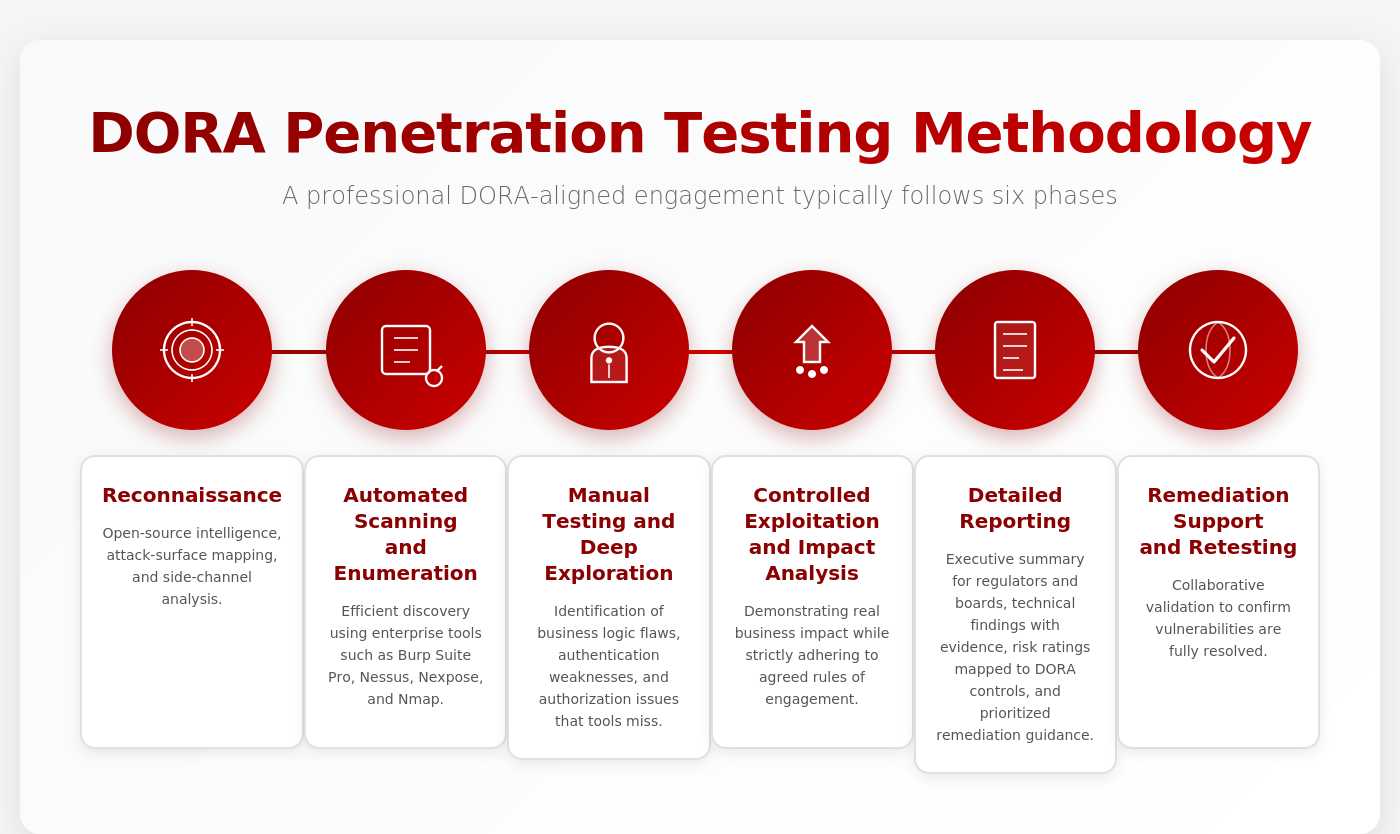
A mature engagement delivers a full technical penetration testing report, a regulator-friendly executive summary, clear remediation priorities, and optional verified retesting. Strong governance, usually led by a dedicated project manager, minimizes disruption and ensures audit readiness. Typical timelines range from 3 to 6 weeks, depending on scope and system complexity.
Pre-Engagement MiCA and DORA Pentest Checklist for 2026
Use this checklist to prepare for your next engagement:
- Confirm required testing type (grey-box versus TLPT)
- Identify DORA-critical business functions
- Define clear rules of engagement and safety controls
- Agree on credentials and documentation access
- Ensure findings map directly to DORA and MiCA controls
- Schedule remediation validation and retesting
- Include deep business-logic and authentication testing
- Assess supply-chain and third-party risks
- Enable collaborative (purple-team) sessions
- Align testing with audit and regulatory timelines
Key Takeaways for Regulated Fintechs in 2026
MiCA and DORA together are raising the cybersecurity bar across European fintech and crypto. Organizations that treat penetration testing as a strategic resilience exercise, rather than a compliance checkbox, achieve meaningful risk reduction, clearer regulatory confidence, and stronger operational resilience. Start early. Focus on risk. Choose a testing partner experienced in regulated environments.
At RedSecLabs we offer no-obligation scoping calls and a detailed, regulator-mapped DORA / MiCA Penetration Testing Checklist including scoping worksheets, evidence expectations, and audit-ready testing considerations. Feel free to reach out.
Contact: www.redseclabs.com | [email protected]