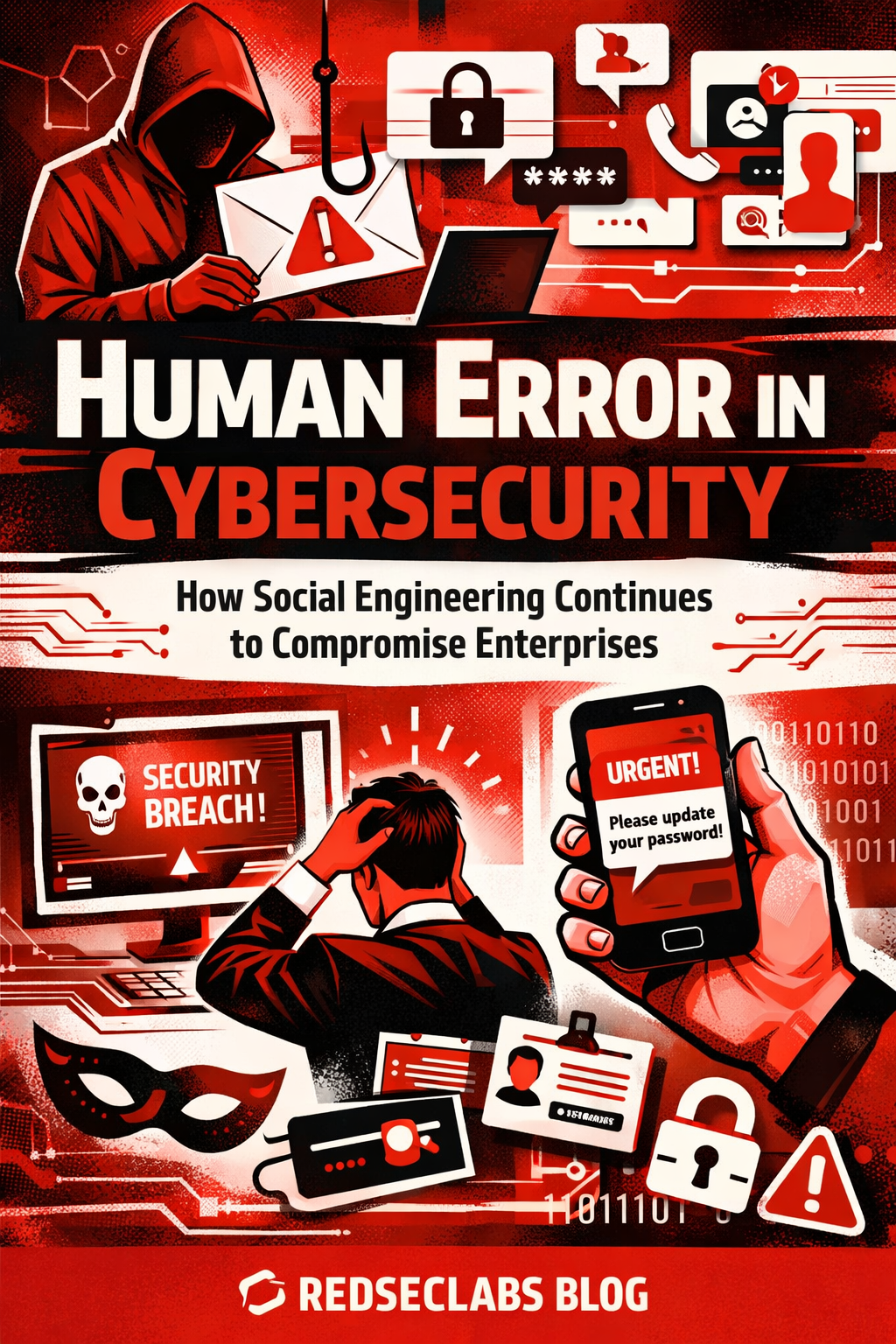
In a world powered by artificial intelligence, machine learning, and complex cybersecurity frameworks, you'd think the biggest threats to organisations would come from ultra-sophisticated code, malware, or direct attacks on infrastructure. But time and again, the downfall begins with something far simpler, human error.
Despite all the technological advancements, social engineering remains one of the most effective tools in a cybercriminal's arsenal. It's not just a weakness but it's the most exploited vulnerability in modern enterprise security. And what's more concerning? It doesn’t require breaking firewalls or cracking encryption. It just requires tricking a person.
This blog post unpacks how human error driven by social engineering is still toppling major organisations and what digital users can do about it. More importantly, we’ll show how a well-equipped Security Operations Centre (SOC) acts as your digital bodyguard, spotting and stopping these threats before they do real damage.
Why Social Engineering Still Works in 2026

Let’s get one thing straight: today’s cyberattacks don’t always start with brute force or technical prowess. They often begin with a simple email, phone call, or message that manipulates human psychology.
Social engineering refers to the art of manipulating people into revealing sensitive information or performing actions that compromise security. And in 2026, this technique will only become more nuanced, tailored, and convincing.
Here’s why it’s still devastatingly effective:
- People trust other people: If an attacker poses as your manager, HR department, or IT helpdesk, most people won’t question it, especially under pressure.
- Remote work is normal: Distributed teams are easier to target. Fewer face-to-face verifications mean more opportunities for attackers.
- Attackers use AI too: Phishing emails are now generated by language models, making them grammatically perfect, emotionally persuasive, and near impossible to distinguish from genuine communication.
Real-World Examples: When a Click Becomes Catastrophic
- The CFO Scam: A finance officer at a multinational company receives an urgent email from the CEO (or so it seems) asking to process a large wire transfer. The language is sharp, there’s a sense of urgency, and it's marked confidential. The transfer goes through and millions are lost.
- The Compromised Contractor: A third-party vendor is phished and unknowingly gives access to their credentials. The attacker uses these to access the enterprise’s internal systems, bypassing perimeter defences entirely.
- The Helpdesk Hook: An attacker calls a junior staff member pretending to be from IT, guiding them to install “essential updates” — which is actually remote access software.
These are not hypothetical stories. They've happened, and will continue to happen, because humans are always the softest target.
The Root of Human Error
It’s not always ignorance. It’s:
- Lack of proper training: Most employees can’t recognise an advanced phishing attempt.
- Stress and multitasking: Rushed decisions lead to skipped verifications.
- Overconfidence: Believing “it won’t happen to me” is the fastest way to become a victim.
- Poor security culture: If people fear reporting mistakes, they’ll hide them allowing the breach to spread.
How to Stay Ahead: Human Awareness That Actually Works
- Don’t just train — educate.
Security awareness needs to go beyond tick-box training. People should be taught to think like attackers:
- What would you do to trick someone?
- How would you exploit a rushed worker?
- What information on LinkedIn or email auto-replies can be weaponised?
- Encourage a culture of caution.
Create a workplace where asking questions and slowing down is encouraged, not punished. Double-checking an email request or calling back a number is not a waste of time — it’s a frontline defence. - Make phishing simulations part of the norm.
Regular, realistic phishing simulations help people stay alert. They normalise suspicion and train staff to spot the subtle red flags. - Lock down access rights.
People should only have access to what they absolutely need. That way, even if credentials are compromised, the damage is limited. - Implement multi-factor authentication (MFA).
Even if someone gives away their password, MFA can stop unauthorised access. It's a basic, powerful shield.
Where Technology Comes In: How a SOC Detects and Defuses Threats
While people remain the target, advanced defences are essential. A well-run Security Operations Centre (SOC) is your enterprise's watchdog like scanning, detecting, and neutralising threats in real time.
Here’s how a SOC helps:
- 24/7 Monitoring: SOC teams monitor traffic, logs, and endpoint behaviour round-the-clock, catching anomalies as they occur.
- Phishing Detection: Using machine learning and pattern recognition, a SOC can detect advanced phishing attempts even those crafted by AI.
- Threat Hunting: SOC analysts proactively hunt for indicators of compromise (IoCs) that may bypass traditional defences.
- Incident Response: If a breach occurs, the SOC coordinates a rapid, structured response containing the threat, investigating the breach, and helping with recovery.
- Behavioural Analytics: By analysing user behaviour, SOC tools can identify if a user suddenly does something out of the ordinary like logging in from a new location or accessing files they’ve never touched before.
From Awareness to Action: A User’s Responsibility
Every digital user has a part to play. It’s not just IT’s job to stay safe. If you use a company laptop, access email, or handle data, you’re on the front line too. Here's what you can do starting now:
- Slow down before clicking anything: Urgency is a red flag in social engineering.
- Verify out-of-band: If someone asks for sensitive action (like money or data), confirm it via a separate channel.
- Use strong, unique passwords and never reuse them.
- Report suspicious activity immediately even if you think it's nothing. Silence lets breaches grow.
- Stay curious: The best defence is a healthy sense of scepticism.
Final Thoughts: Humans Are the Weak Link But Also the First Line of Defence
The most advanced firewall in the world means nothing if someone clicks the wrong link. Human error, fuelled by clever social engineering, is still the number one reason companies get breached no matter how sophisticated their tech.
But awareness is power.
The more users understand the threat, the harder it becomes for attackers to succeed. And with a robust Security Operations Centre backing you up, capable of detecting advanced phishing and reacting in real time, you get a dual-layered defence: informed humans and sharp-eyed machines.
Cybersecurity isn’t just an IT problem. It’s a human one. Fix the people problem, and you fix 90% of the threat surface.
Need help building your defences?
A well-equipped SOC can detect phishing, respond to breaches, and support your team through every incident. We can help you design a human-centric, tech-backed defence that protects your business where it counts, at the point of human contact.
Let’s build a smarter security culture, together.