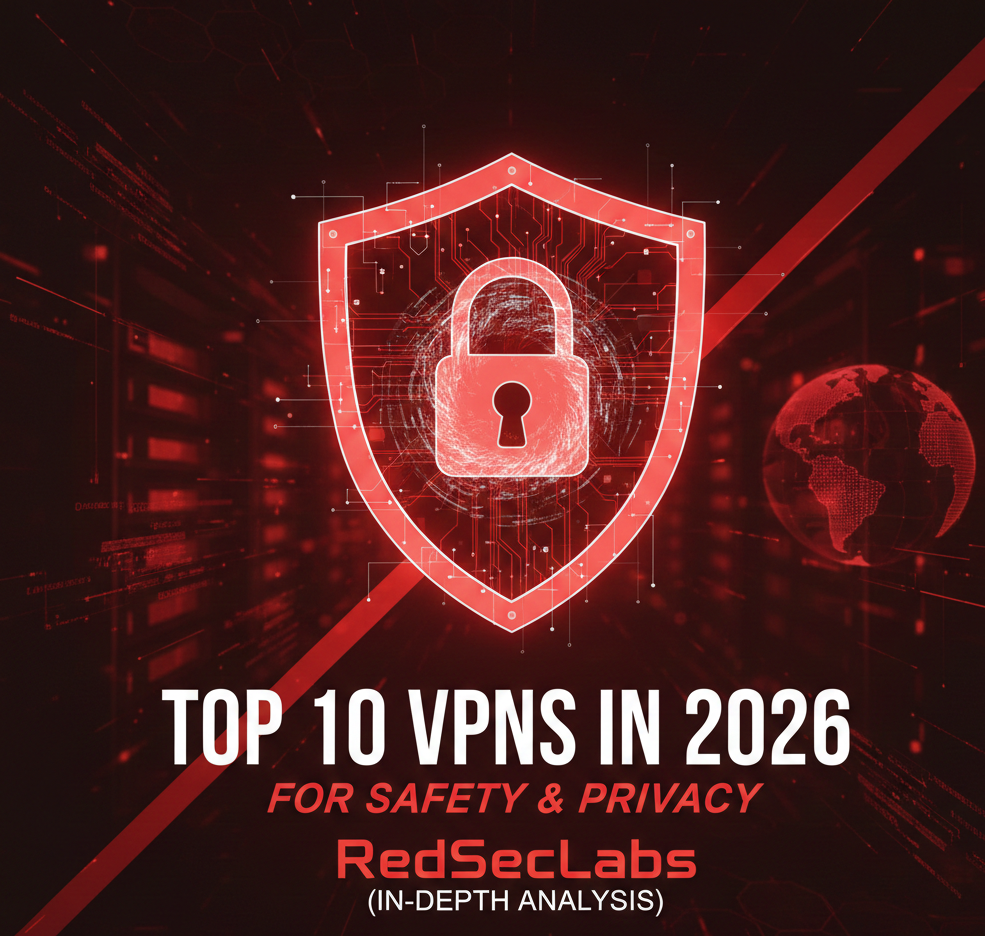
We wrote about Top 10 VPN’s in 2025 from security and privacy standpoint, However, much changed in 2025, leading to major shifts in VPN rankings. Some security vulnerabilities, such as IP leaks, were disclosed, while several VPNs improved their privacy and transparency. Hence, we now present our report on the Top 10 VPNs in 2026.
VPNs are effectively a tool that encrypts internet traffic and masks users' IP addresses, in attempts to make online activities more private and secure. They are commonly used to bypass geo-restrictions, protect data on public Wi-Fi, and prevent ISPs from tracking browsing activity.
While VPNs don’t guarantee anonymity, they do enhance privacy to a certain extent by encrypting data and routing it through their servers. However, their effectiveness largely depends on factors such as the VPN provider’s logging policy, jurisdiction, and encryption standards.
However we are yet to come across a ranking that makes security and privacy the primary rating criteria, especially one that rewards providers who consistently validate their claims through independent audits and penetration tests.
Quick Answers (2026) — Best VPN for Security & Privacy Concerned Users
Q. What is the best VPN in 2026 for privacy and security?
A. ProtonVPN ranks #1 in 2026 due to it's jurisdiction, strong transparency, and materially improved verification signals (SOC 2 Type II + consecutive no-logs verification), alongside Secure Core and Tor-over-VPN support.Q. Which VPN has the strongest anonymous signup model?
A. Mullvad (no email, random account numbers, cash/Monero support).Q. Which VPN has the most mature infrastructure footprint?
A. NordVPN remains the infrastructure titan, but drops to #2 in 2026 due to heightened scrutiny after a January 2026 third-party environment exposure allegation (no user data compromise evidenced).
Choosing the best VPN in 2026 means balancing security and privacy. After extensive independent research, we’ve ranked the top 10 VPN services based on the following criteria:
VPN Criteria
- Jurisdiction – Privacy-friendly location outside Five, Nine, and 14 Eyes alliances; stable political climate and strong internet privacy laws.
- Security Features – Robust encryption, reliable kill switches, RAM-only servers (or hardened disk-encrypted alternatives), DNS/IP leak protection, advanced protocols (WireGuard, MultiHop) etc.
- Privacy & Anonymity – Independently verified no-logs policy, minimal data collection, anonymous payments, GDPR/CCPA compliance, and resistance to legal data requests.
- Transparency – Frequency, comprehensiveness, and rotation of third-party no-log and security audits, public penetration test disclosures, and transparent incident communication.
- Proprietary Security Tools – Effectiveness of obfuscation, Tor-over-VPN, automatic key-rotation practices, dedicated privacy browsers, and unique privacy solutions.
- Vulnerability Management – Track record in handling security flaws, IP leaks, CVEs, and response times to fixing critical vulnerabilities.
Scoring System (0–5 per criterion)
- 0–1: weak / high-risk / poor verification
- 2: acceptable but material concerns
- 3: good baseline with some gaps
- 4: strong, repeatedly verified
- 5: best-in-class signals + consistent verification
Max score = 30 (6 criteria × 5 points).
Top 10 VPNs in 2026 for Security & Privacy:
ProtonVPN claims the first place for 2026 as it combines perfectly jurisdictional protection, transparency, and independent verification of security controls.
1. ProtonVPN
Jurisdiction: Switzerland
Ranking Change: ↑ #3 → #1

ProtonVPN is headquartered in Switzerland, a country known for strong data protection laws and independence from the Five, Nine, and 14 Eyes alliances. It follows a strict no-logs policy that has been independently verified through four consecutive annual audits, demonstrating sustained commitment rather than one-off compliance theater.
Security highlights include Secure Core multi-hop routing, which routes traffic through privacy-hardened data centers in Switzerland, Iceland, and Sweden before exiting to protect against network-level adversaries. It supports Tor-over-VPN integration for additional anonymity layers, and all ProtonVPN applications are fully open-source and independently audited, enabling public security verification.
In 2025, ProtonVPN received 59 legally binding data requests and denied all 59, citing Swiss law and its strict no-logs policy. This demonstrates that even when courts order data disclosure, there is no VPN activity data to provide. ProtonVPN publishes comprehensive transparency reports detailing every legal request, the legal basis, and the outcome, making it one of the few providers to do this with specificity.
No breaches, leaks, or law-enforcement compliance incidents were recorded in 2025–2026. ProtonVPN ranks #1 due to its combination of favorable jurisdiction, proven legal resistance track record, consecutive independent verification, and advanced security architecture.
2. NordVPN
Jurisdiction: Panama
Ranking Change: ↑ #1 → #2

NordVPN is still considered one of the most technologically advanced VPN providers in the world. It is equipped with post-quantum-ready NordLynx protocol, Operationally, it remains one of the most mature VPN providers in the industry.
In January 2026, unverified claims circulated on cybercrime forums alleging exposure of development-environment data involving Salesforce and Jira schemas.
NordVPN stated that the material originated from an isolated third-party testing environment and confirmed that no production systems or user data were affected. While no evidence of user-log compromise has emerged, the episode highlights the importance of continuous audit transparency and ongoing security monitoring.
3. Mullvad
Jurisdiction: Sweden (14-Eyes)
Ranking Change: ↑ #4 → #3

Mullvad remains the gold standard for anonymous account architecture. It offers unparalleled signup privacy with no user email addresses, no personal information, random numbers for bank accounts, and help for financial and Monero payment methods.
Mullvad passed several independent audits in 2025 without any high-severity findings. In order to lessen the attack surface, it unveiled reproducible Android builds, post-quantum WireGuard, and plans to completely phase out OpenVPN in early 2026.
Its no-logs claims were proven in practice when Swedish police raided its office under a German warrant and left empty-handed because no customer data existed to seize.
4. ExpressVPN
Jurisdiction: British Virgin Islands
Ranking Change: ↓ #2 → #4

ExpressVPN still operates high-quality Trusted Server RAM-only infrastructure, uses its custom Light way protocol, and has completed more than 23 audits.
However, in April 2025, a critical Windows IP leak exposed real IP addresses for RDP traffic its second major leak since 2022. Combined with ongoing concerns around Kape Technologies ownership, these repeated leak-class failures materially weaken trust in a security-first evaluation.
5. Surfshark
Jurisdiction: Netherlands (14-Eyes)

Surfshark continues to improve technically, introducing Everink self-healing infrastructure, higher throughput servers, and passing a no-logs audit in 2025. No public breaches were recorded in 2025 or 2026. Still, jurisdictional exposure and past tunnel-failure narratives remain cautionary for users with high-risk threat models.
6. CyberGhost
Jurisdiction: Romania

CyberGhost's entire server environment operates in RAM-only mode, frequent transparency reports every three months, and an extremely tight no-logs policy that has been verified by Deloitte are some of the things that characterize the company. The data retention laws in Romania are non-existent and the country is not part of any intelligence-sharing treaties, so it is considered a safe place for data storage.
The scale of its infrastructure is pretty huge; however, the frequency of its audits and the amount of security disclosures made to the public are similar to those of the second-tier providers.
7. IVPN
Jurisdiction: Gibraltar

VPN stands out for radical transparency. It publishes regular transparency reports, refuses affiliate marketing, supports zero-data signup, and completed its 7th Cure53 audit in 2025. Its refusal to use affiliate marketing, zero-data signup, firewall-based kill switch, and V2Ray obfuscation make it one of the most ethically operated VPNs.
However, slower audit cadence and smaller infrastructure footprint prevent it from overtaking top providers.
8. Hide.me
Jurisdiction: Malaysia

Hide.me has a recorded audit of no-logs, RAM-only servers, WireGuard support, IPv6 handling, and Stealth Guard features. It was incident-free during the years 2025 and 2026 but disclosed fewer penetration-testing results than top competitors.
9. IPVanish
Jurisdiction: United States (Five-Eyes)
IPVanish's no-logs audit of 2025 was passed successfully, and it was in the process of transitioning to RAM-only servers at various points. However, the company's past logging scandal and U.S. jurisdiction still place it in the lowest ranks of security-critical use cases.
10. Private Internet Access (PIA)
Jurisdiction: United States
PIA has been to court many times and always proved its no-logs claims; it also provides open-source applications supported by RAM-only infrastructure. Even so, Kape ownership and surveillance laws in the United States are hindering its use by journalists and high-risk users.
Why PureVPN Was Excluded (2026)?
PureVPN was excluded due to Linux IPv6 leaks in 2025, firewall rule corruption, slow responsible disclosure response, and long-standing trust issues stemming from past logging cooperation.
In a security-first ranking, IP-exposure vulnerabilities are disqualifying, not minor bugs, because they break the core promise of a VPN.
RedSecLabs deep dive:
PureVPN Linux Client Faces Critical Vulnerabilities
Why our 2026 rankings differ from mainstream reviews:
Most VPN rankings prioritize speed and streaming. We prioritize independently verified security, proven legal resistance, and real-world privacy testing. ProtonVPN ranks #1 because it denied all 59 legal requests in 2025 not because it has the fastest speeds.
ExpressVPN ranks #4 despite excellent infrastructure because we heavily penalize leak-class failures (this is its second major IP leak since 2022).
The analysis provided is thorough and aligns with current publicly available information on VPN security and privacy practices. For further updates or corrections, contact: [email protected]
Independent Security Assessments for VPN Providers
RedSecLabs provides independent penetration testing and security audits for VPN providers committed to transparency.
Our team has a proven track record of identifying and responsibly disclosing CVEs in VPN infrastructure, client applications, and protocol implementations. We specialize in comprehensive security assessments that help providers demonstrate verified security posture rather than relying on marketing claims alone.
Why Work With Us?
Independent third-party verification is increasingly the standard that security-conscious users demand. Providers who invest in regular, transparent security assessments rank higher in trust-focused evaluations and differentiate themselves in a crowded market.
Interested in strengthening your security posture with independent verification?
📧 Contact: [email protected]
🔗 Our CVE Disclosures: https://www.redseclabs.com/security-research
All assessments are conducted under NDA with flexible disclosure timelines that respect your remediation process.